NEWS PADLOCK CEN GRADES AND BS EN 12320: A PRACTICAL OVERVIEW
Padlock CEN Grades and BS EN 12320: A Practical Overview
17 March 2026
Most customers don’t ask about standards. They ask, “Is this a good padlock?”
In the UK, the best thing you can do to give your customers an answer that goes beyond the “heavy duty” claims which flood the market is to look at BS EN 12320.
What is BS EN 12320?
BS EN 12320 is the British standard for padlocks. If a lock is rated under it, it’s been tested against a consistent set of criteria:
- Resistance to physical attack (cutting, pulling, twisting).
- Durability (how it holds up over repeated use).
- Corrosion resistance (how it survives outdoors).
- Key security.
Relying on BS EN 12320 when recommending a padlock means the lock has been tested against a shared benchmark, with results that are comparable across manufacturers—so you’re not relying purely on branding or price.
Because of that, you’re not just answering “does it lock?”, but also the more important question: how long does it hold when someone really wants it open?
BS EN 12320: The Classification System
BS EN 12320 grading appears as a 7-digit code where only two include a proper grading. The first one refers to the padlock’s weather resistance.
The second one refers to its security grade, which matches the CEN grade scale from 1 to 6 (1 being low security, 6 being high security).

Corrosion resistance
Two grades are available:
- Grade 1: internal applications.
- Grade 3: external applications
When choosing a padlock for harsh environments, you can also look at the padlock's IP rating. Read our guide here: https://www.keyprint.co.uk/news/ip68-padlocks-what-are-the-benefits.
Security requirements
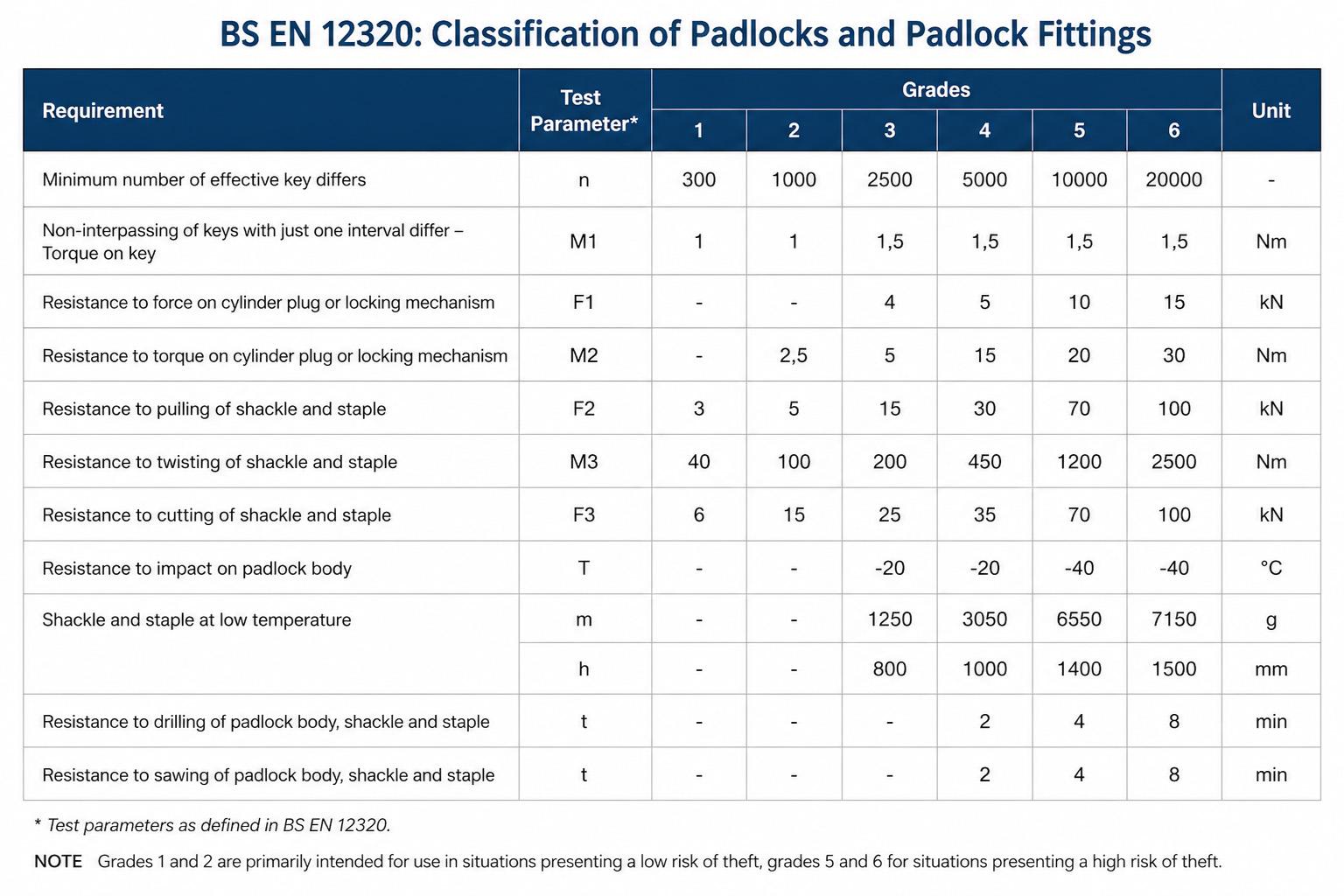
Padlocks are graded from 1 (lowest) to 6 (highest). Security requirements under the standard closely follow the CEN grading system for padlocks that ranks security performance from Grade 1 to Grade 6.
The testing puts padlocks through controlled, repeatable abuse to test their resistance to:
- Pulling.
- Twisting.
- Cutting.
- Impact.
- Freezing.
- Drilling.
- Key differentiation and more.
Let’s have a look at the table below:
Understanding Security Grades
CEN grades offer a straightforward comparison of security levels. They help you choose the right padlock for various real-life situations.
Low-risk indoor lockers use Grade 1. For toolboxes and basic storage, Grade 2 offers better security.
Grade 3 is ideal for sheds, gates, and light commercial access, providing enhanced protection.
For vans, storage, and depots, choose Grade 4. Grade 5 suits tougher environments like utility sites or remote locations.
Grade 6 is essential for high-value assets, infrastructure hubs, and military applications.
Practical Advice for Locksmiths
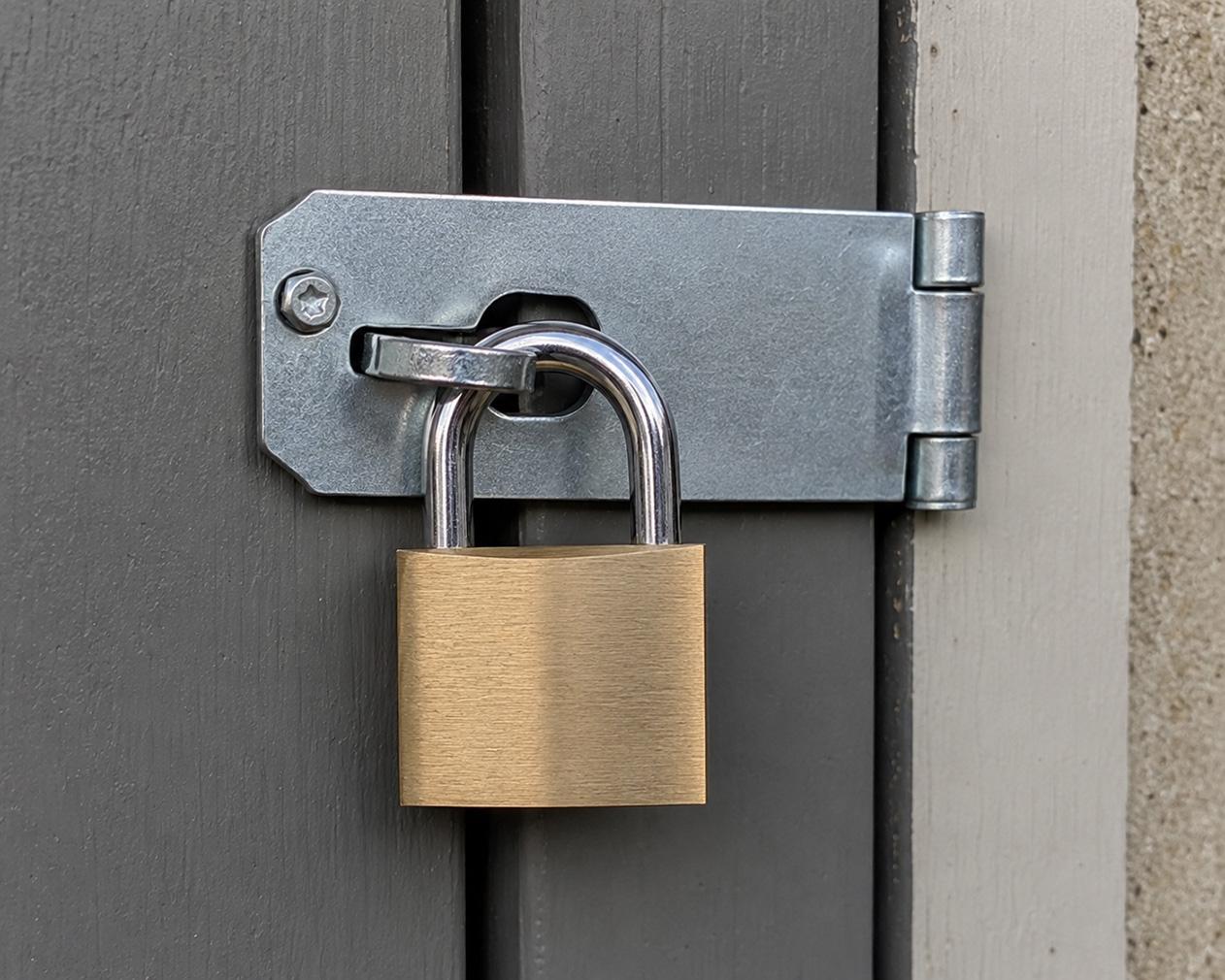
A high-grade padlock on a weak hasp is pointless. You can fit a Grade 5 lock, but if the staple bends or the fixings fail, that’s what gives way first. The lock is only as strong as what it’s attached to.
What’s actually being secured? Where is it located? What’s a realistic method of attack in that setting? Are there any insurance requirements that need to be met? And does key control matter beyond simple convenience?
You don’t need a long checklist on paper, but running through those points mentally tends to catch most issues before they become call-backs. That usually tells you the right grade for that job.
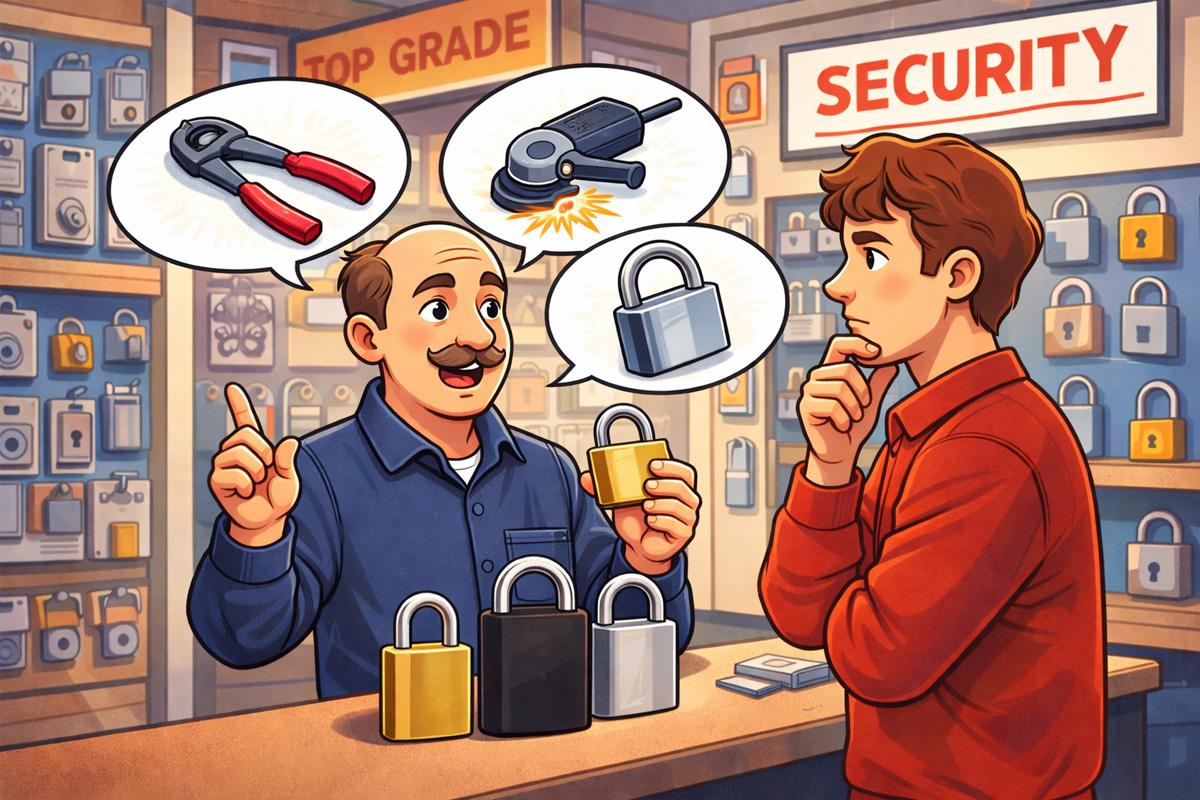
And not every single job needs the highest grade. Balance the risk, the budget, and how it’s being used. The real value is also in explaining that to customers. Most people don’t see the difference between a £15 padlock and a £60 one until you show them, especially in terms of how long each will hold up under attack.
Common Mistakes to Avoid
Ignoring CEN ratings entirely is one of them, and relying on “heavy duty” labels instead of something measurable. Using indoor padlocks outside is another, especially in exposed areas.
Open shackles tend to get specified where they shouldn’t, simply because they’re easier to fit, and key control is often overlooked until it becomes a problem later.
But probably the most common mistake is still pairing a strong padlock with weak fittings. It looks secure, but it doesn’t behave that way when it’s tested.
Conclusion
Standards like BS EN 12320 give you a baseline. They tell you what a padlock can do in controlled conditions.
But in practice, security is never just the padlock. It’s the padlock, the hasp, how it’s fitted, and how it’s used day to day. Get that combination right, and the rating starts to mean something.
What sets us apart?
We deliver personalized solutions, ensuring that every customer receives top-tier service tailored to their needs.
Is the website user-friendly?
Our website is designed for easy navigation, allowing you to find the information you need quickly and efficiently.
Can you trust our partners?
We collaborate with trusted, high-quality partners to bring you reliable and top-notch products and services.
What support do we offer?
We provide 24/7 support through various channels, including live chat, email, and phone, to assist with any queries.
How is your data secured?
Your data is protected by advanced encryption and security protocols, keeping your personal information safe.
Are links to other websites approved?
Although this Website may be linked to other websites, we are not, directly or indirectly, implying any approval.